THE SOLOMONIC GUIDE
The Key of Solomon is not a service. It is a manual written in the second person - thou shalt, thou must - and every reseller since has quietly deleted that. So this is a manual too: the pentacle the text assigns to your intent, your own planetary hours solved for your latitude and longitude, the operation in the text's own words with chapter citations, and then it stops. The charge panel is left blank because Book II tells us to leave it blank. That part is yours.
- Public-domain sources, cited by book and chapter
- Real arithmetic - Swiss Ephemeris, Agrippa's tables, the sunrise equation
- Every number printed on the page, so it can be checked
- No outcome promised, ever - the gap is printed too
Every part of it, named
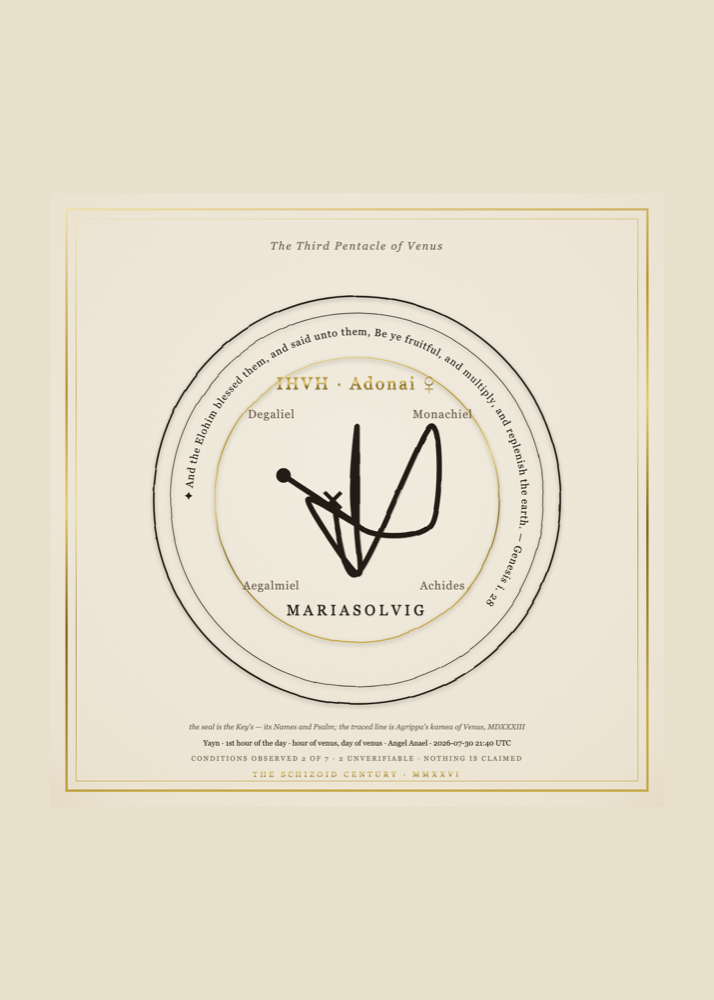
The clavicula plate
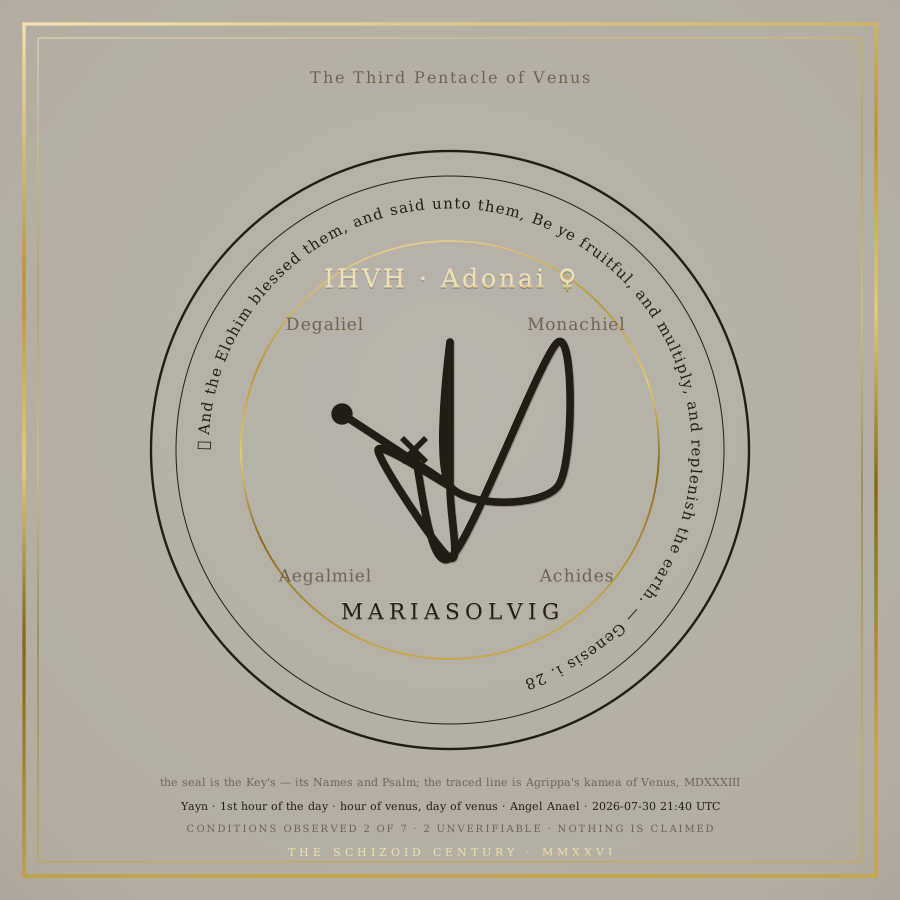
Your traced line carrying the Key's real seal DNA: the divine Name at the centre, the four angel names, the scripture versicle ringing the figure.
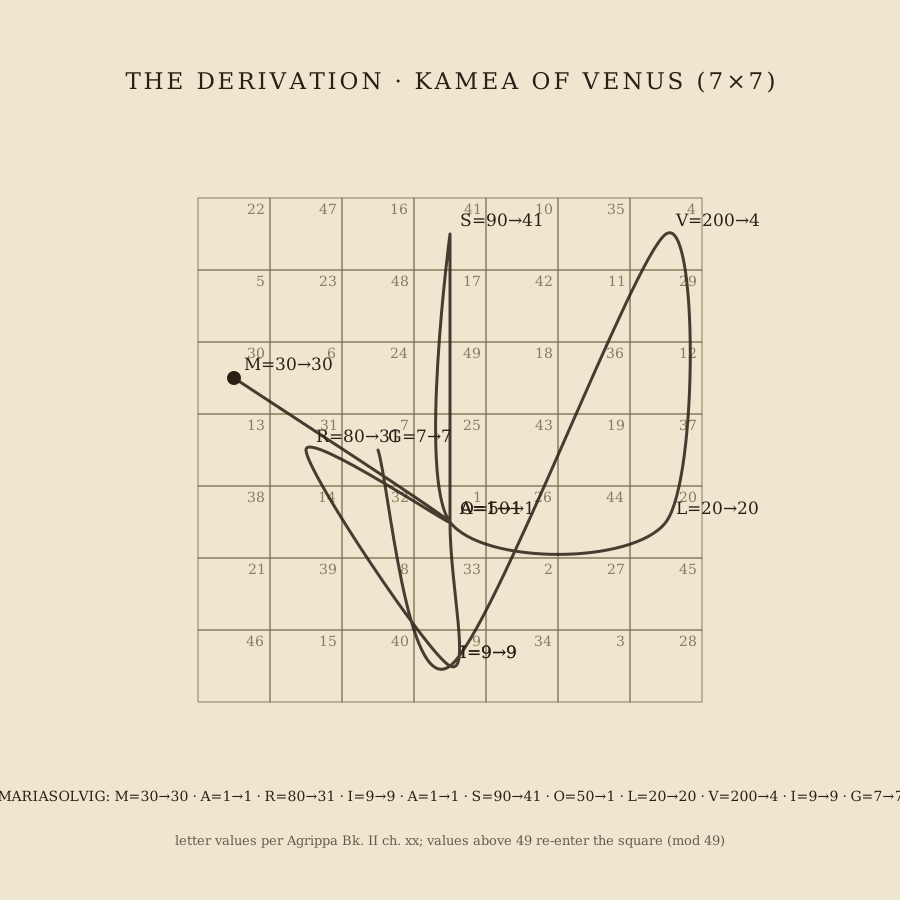
The derivation
The square with every letter, value and cell numbered - the receipts for the line.
The ten-page guide
A4 document: what the Key says your hours are for, your hours computed for your city, the procedure for solving an hour yourself, the stroke-by-stroke account, the blank charge panel, and the observance table.
The print set
The plate rendered at A4, US Letter, 8x10, 5x7 and 8x8 square - ready for a frame with no re-scaling.
The manifest
kit.json: your order, the pentacle chosen, the hour used, and the seven ritual conditions with which ones were actually met.
A guide is judged by what it leaves you able to do
Solve an hour
Work out the ruling planetary hour at any moment, at any latitude, from sunrise and sunset.
Derive the week
Show why the weekday names are the Chaldean order's arithmetic and not a coincidence.
Audit a condition
Read the Key's seven operating conditions and judge which are computable, which are unknowable.
Check a seal
Trace a pentacle back to the chapter that assigns it, and verify the divine Name and versicle.
The instrument, in the open
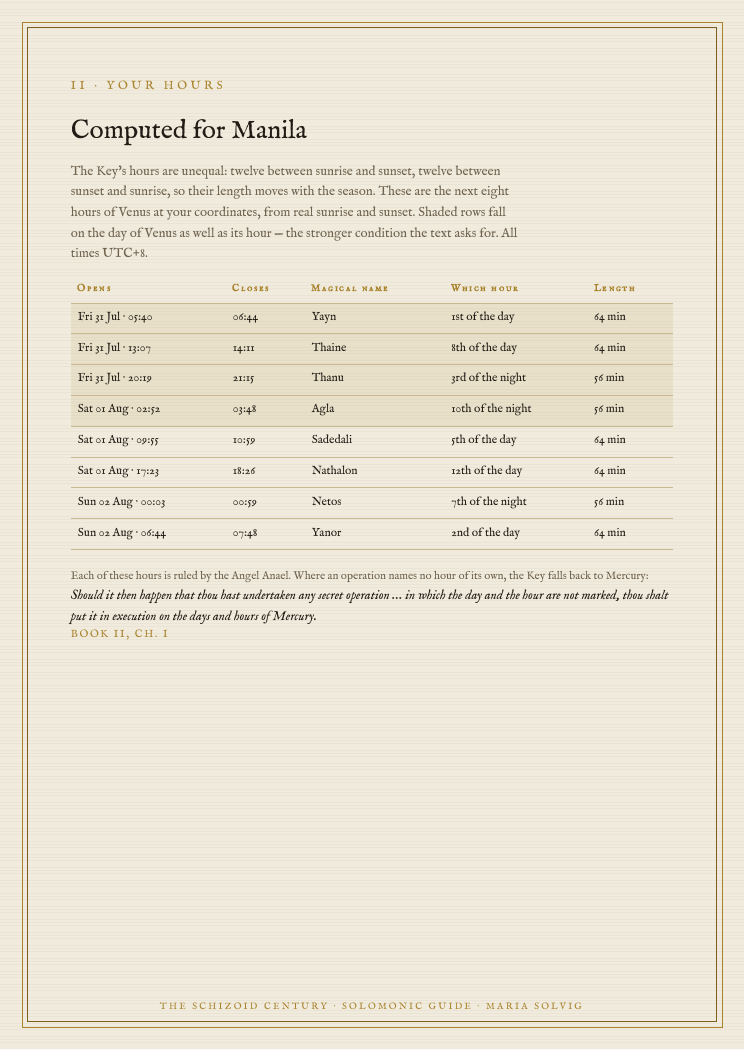
Your hours, from the sunrise equation
Planetary hours are not clock hours - the day divides into twelve unequal parts between sunrise and sunset, and the night into twelve more. We solve sunrise and sunset for your coordinates with the NOAA equation and walk the Chaldean order from the day's ruler.
The Key's own pentacle, matched to the intent
Book I, chapter XVIII gives a set of planetary pentacles. We select the one whose stated office matches what you asked for - never a malefic one - and reproduce its divine Name, its angels and its versicle with the chapter and scripture cited.
Two corpora, never blended
The Key of Solomon (Mathers, 1889) supplies the pentacle, the hours and the conditions. Agrippa (1533) supplies the letter table and the square. Both are public domain, both are on disk, and the sheet always says which one it is quoting.
The charge panel is left blank on purpose
Book II, chapter XXI directs that the divine Name be written at the beginning, Ain Soph at the end, “and between these Names write what thou wishest”. That space is yours. We print the frame and leave the middle empty.
The reasons, stated
Because the operation is the artifact, not a promise
A kit that guaranteed a result would be lying, and the text it is drawn from never does. The Key issues instructions to an operator. This kit gives you the instructions, the arithmetic and the frame - the part only you can do is left undone, visibly.
Because the conditions are printed even when they fail
Seven conditions are demanded by the source: the hour, the day, the Moon's sign, before sunrise, the beginning of August, virgin parchment, a state of grace. Your manifest lists all seven and marks each met, unmet or unknowable. Most were unmet. We print that.
Because describing is not prescribing
The corpus specifies things - blood, sacrifice, ingestion - that we report and never direct. The sheet quotes what the text commands its operator to do; it never instructs you to do it.
Actual output, unretouched
Read the complete ten-page specimen · PDF, 5.4 MB
No reviews to show yet - so here is the entire product instead, before you pay.
What the $5 version leaves out
| The Solomonic Guide | The usual $5 app report | A chatbot answer | |
|---|---|---|---|
| Names its source by book and chapter | yes | no | sometimes, often wrongly |
| Prints the arithmetic so you can re-run it | yes | no | no |
| Same input gives the same output, years later | yes | no | no |
| States plainly what cannot be verified | yes | no | rarely |
| Built to print and hand over | yes | screen only | no |
| Teaches you the method, not just the answer | yes | no | no |
| Runs on data you did not report about yourself | yes | no | no |
| Leaves you holding something you wrote | yes | no | no |
| Promises you an outcome | never | usually | if asked |
We would rather you skipped it than regretted it
Buy it if
- Anyone who has read a grimoire and wanted the arithmetic checked, not the drama amplified
- Practitioners who want the hours right for their own coordinates, not a generic table
- Collectors of documents - five print ratios, framed as easily as filed
- Anyone buying one gift that will actually be kept
Skip it if
- Anyone wanting a spell that works; the sheet states that nothing is claimed
- Anyone wanting instructions to follow - the text is reported, never prescribed
- Anyone who cannot supply a city; without coordinates the hours cannot be solved
What happens after the button
You send the details
Three or four fields. No account, no birth-chart quiz, no upsell page.
It is cast by hand
Your document is generated, then read before it goes out. If the hour gate defers the tracing, you are told the exact window it is waiting for.
It arrives as a file
A print-grade PDF, or SVG line art for a sigil. Yours to keep, reprint and hand on - no platform, no login, no expiry.
- The name to trace, and what the work is for
- Your city - we need the latitude and longitude to solve your hours
- Your UTC offset, so the windows land on your clock
A kit can be cast on someone else's name and city - the hours computed where they live, not where you do.
The correction guarantee
If any number in your document is wrong - a longitude, an hour, a citation, a cell on the square - tell us and you get a full refund, and the correction is published in the journal with your order number on it. If the document does not look like the specimen you read before buying, same terms.
What is deliberately not guaranteed: an outcome. No sigil, hour or placement is claimed to cause anything, and no refund is owed for a life that carried on as normal.
Asked and answered plainly
Do I have to perform anything?
No. Every page reads as a document on its own, and nothing in the kit requires you to do a thing. The blank charge panel is an invitation, not an instruction.
What are planetary hours, exactly?
The old division of the day: twelve unequal hours from sunrise to sunset, twelve more from sunset to sunrise, each ruled by a planet in the Chaldean order. It is also why the weekdays are named for planets - the arithmetic still works, and the rite sheet shows it.
How is this different from the plain sigil?
Same price, different scope. The sigil is the plate and its receipts; the kit adds the Key's own pentacle, the ten-page guide with your own hours, the five print ratios and the observance manifest. Same traced line at the centre; the kit is the whole operation around it.
Is any of this claimed to work?
No, and the documents say so in print. What is claimed is narrower and checkable: the quotations are verbatim with citations, the hours are correct for your coordinates, and the line is reproducible from your name.
Go and check us
Two public-domain editions carry every quotation in these documents. Both are linked so you can read the passage yourself - that is the point of citing by chapter.
The Key of Solomon the King (Clavicula Salomonis)
translated by S. L. MacGregor Mathers, 1889 · read the scan at the Internet Archive
The pentacles of Book I ch. XVIII, the planetary hours and virtues of ch. IV, the operating conditions of ch. VIII, and the blank-name instruction of Book II ch. XXI.
Three Books of Occult Philosophy
Heinrich Cornelius Agrippa, 1533; Whitehead edition, 1898 · read the scan at the Internet Archive
The Latin letter table of Book II ch. xx and the seven planetary kameas of ch. xxii - the letter values and magic squares every traced sigil walks.
Cast from the same sources
The Chart Guide
A sixteen-page workbook: your chart derived across six areas of a life, then eighteen questions to answer in your own hand. No forecasts, every number cited.
See the pageThe Sigil Guide
A seven-page guide to Agrippa's 1533 kamea method, worked on your own name: letter values, the square, the traced route, every step numbered and checkable.
See the pageAll Three, Cast Together
Already reading about The Solomonic Guide? Add The Chart Guide and The Sigil Guide for less than the two of them.
$56.94 separately $32.98
· you keep $23.96