THE SIGIL GUIDE
Anyone can generate a pretty glyph and call it a sigil. Seven pages here give you the actual method - Agrippa's Latin letter table printed in full, the modular rule that puts a value on a square, the route across it - then run it on your own name step by step, and hand you the table for choosing the next planet. You finish able to trace one without us, which is the only honest thing a guide can promise.
- Public-domain sources, cited by book and chapter
- Real arithmetic - Swiss Ephemeris, Agrippa's tables, the sunrise equation
- Every number printed on the page, so it can be checked
- No outcome promised, ever - the gap is printed too
Every part of it, named
The seven-page guide
The method entire: Agrippa's letter table printed in full, the modular reduction rule stated, your own name worked line by line, the seven squares and what the Key assigns each, how to audit any sigil, and the honest gap.
The plate
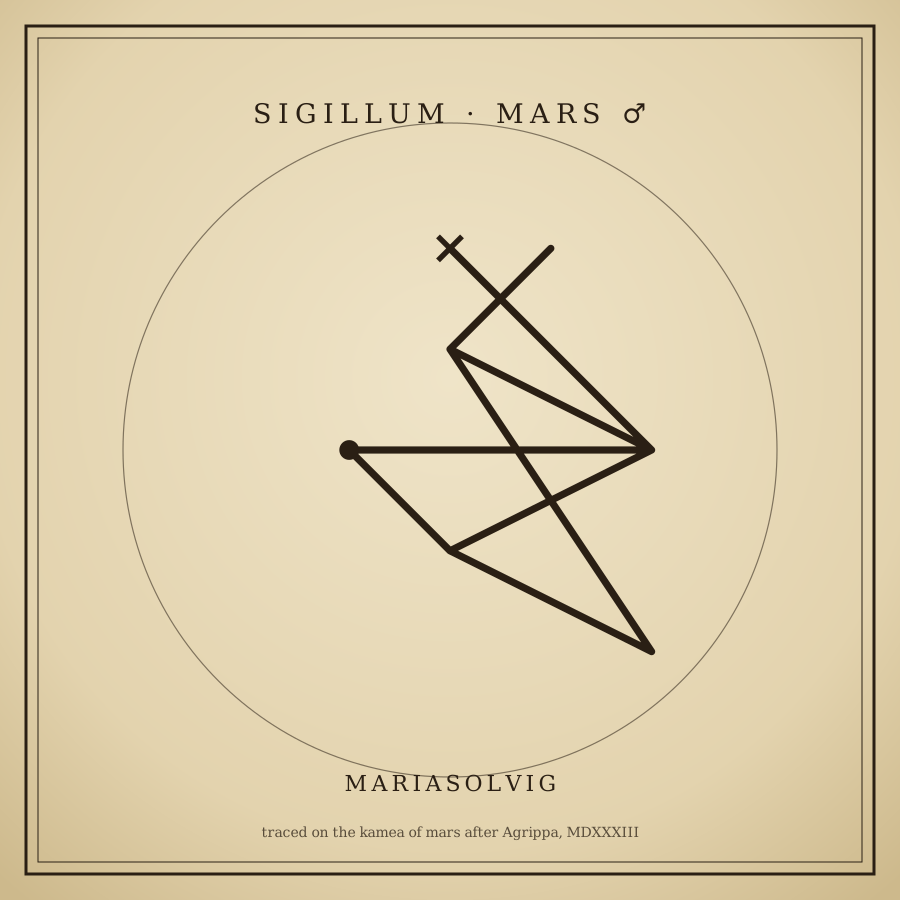
The finished sigil on cream stock: planet glyph, the traced line, your name set in script, the hour it was drawn.
The derivation
The same square with every step numbered - letter, value, cell - so the line can be re-walked by hand.
The receipts
A small JSON file recording the letter values, the planet, the intent and the exact hour. Machine-checkable.
Scalable line art
Delivered as SVG: print it at business-card size or at a metre wide with no softening.
A guide is judged by what it leaves you able to do
Convert a name
Run any name through Agrippa's Latin letter table, including the period's J/I and U/V/W handling.
Walk a kamea
Reduce those values onto any of the seven planetary squares and trace the route by hand.
Pick the planet
Match an intent to its planet the way the Key's own list does, instead of by vibe.
Tell derived from drawn
Look at a sigil and know whether anything actually generated it.
The instrument, in the open
Agrippa's letter table, not a numerology app
A=1, B=2 ... V=200, X=300 - the Latin gematria from Book II, chapter xx, with the period's J/I and U/V/W handling. Your letters become numbers the way the 1533 text says.
Reduced onto the planetary square
Each value is reduced modulo the kamea of your planet - the magic squares given in Book II, chapter xxii - then the line is drawn from cell to cell in order. Same name, same planet, same sigil, forever.
The planet comes from the intent
Love, friendship and travel run to Venus; courage and enemies to Mars; eloquence and business to Mercury - the assignments the Key of Solomon itself lists. Or name the planet yourself.
Drawn inside the planetary hour
The tracer computes the unequal planetary hours for the day - the Chaldean order the grimoires prescribe - and refuses to draw outside the planet's own hour. If it refuses, it prints the next valid window.
The reasons, stated
Because a generated squiggle is not a sigil
Anything can output a pretty glyph. What makes this one yours is that the path is forced: your letters, that square, one legal route. The derivation page exists so you can check we did not cheat.
Because determinism is the honest kind of magic
Same input, same output, forever - no seed, no model, no drift. If you lose the file in ten years, the identical plate can be re-traced from your name alone.
Because there is more than one method, and we say which one this is
The kamea route is the historical one - Agrippa, 1533. The word method most modern practitioners use descends from Austin Osman Spare in the early twentieth century, and the pictorial and mantric variants are later still. The guide names that lineage instead of implying one true method, and then shows you the old one properly.
Because the explanations disagree, and pretending otherwise is the lie
Ask why a sigil would do anything and you get two incompatible answers: a psychological one about attention and the unconscious, and a magical one about acting on the world directly. Neither is testable from a plate. The guide states both and endorses neither - that is what the third register is for.
Because the sources set the conditions, so we keep them
The texts are emphatic about hours and days. We can compute those exactly, so we do - and the plate prints which conditions were met and which were not.
Actual output, unretouched
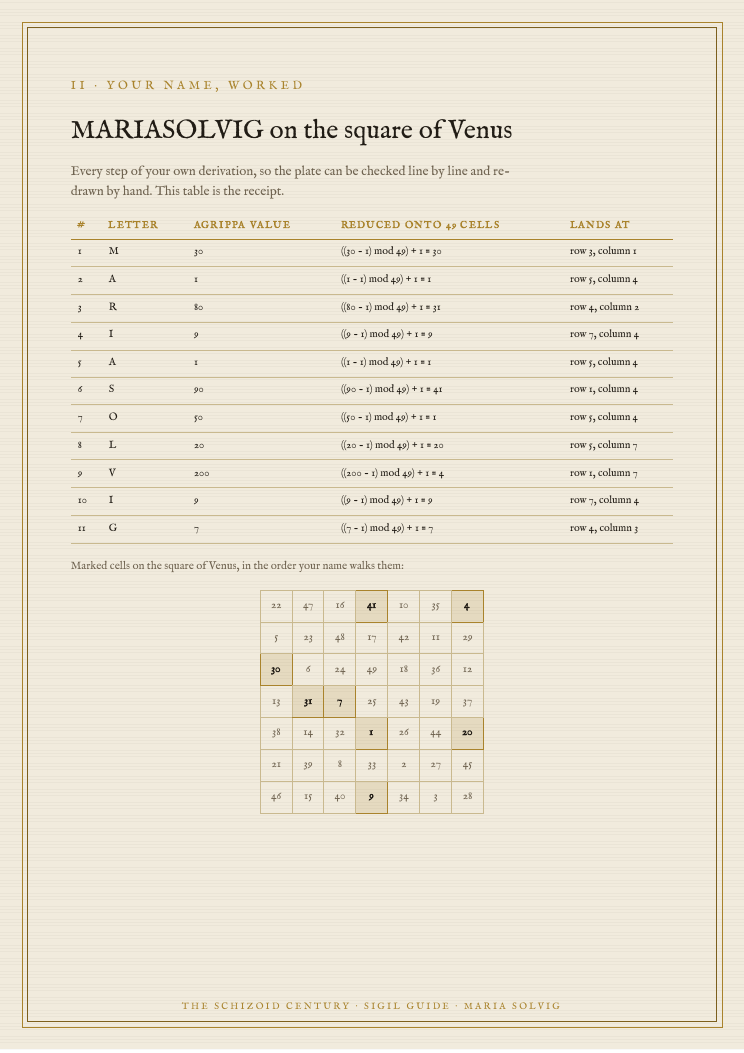
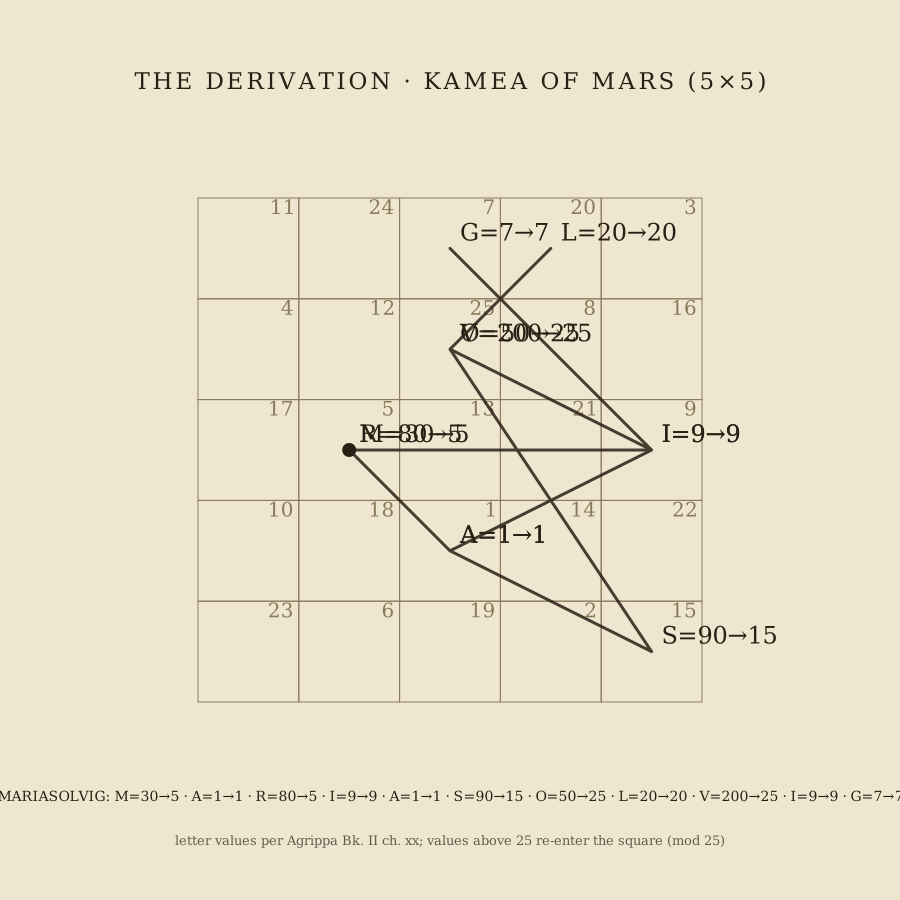
Read the complete seven-page specimen · PDF, 2.4 MB
No reviews to show yet - so here is the entire product instead, before you pay.
What the $5 version leaves out
| The Sigil Guide | The usual $5 app report | A chatbot answer | |
|---|---|---|---|
| Names its source by book and chapter | yes | no | sometimes, often wrongly |
| Prints the arithmetic so you can re-run it | yes | no | no |
| Same input gives the same output, years later | yes | no | no |
| States plainly what cannot be verified | yes | no | rarely |
| Built to print and hand over | yes | screen only | no |
| Teaches you the method, not just the answer | yes | no | no |
| Runs on data you did not report about yourself | yes | no | no |
| Leaves you holding something you wrote | yes | no | no |
| Promises you an outcome | never | usually | if asked |
We would rather you skipped it than regretted it
Buy it if
- Anyone who wants a personal mark with a real derivation behind it
- Tattoo, print, bookplate, pendant - line art at any size, no softening
- The cheapest honest way to see whether this house's work is for you
- A gift with a page of receipts attached
Skip it if
- Anyone expecting the sigil to do something - nothing is claimed, in print
- Anyone who wants it designed to taste; the arithmetic decides the shape
- Anyone in a hurry during the wrong planetary hour - the tracer waits
What happens after the button
You send the details
Three or four fields. No account, no birth-chart quiz, no upsell page.
It is cast by hand
Your document is generated, then read before it goes out. If the hour gate defers the tracing, you are told the exact window it is waiting for.
It arrives as a file
A print-grade PDF, or SVG line art for a sigil. Yours to keep, reprint and hand on - no platform, no login, no expiry.
- The name to trace - exactly as it should be spelled
- What it is for - one word: love, courage, business, voyages ...
- Or name the planet yourself, if you know which one you want
Traced on someone else's name and sent to them as a plate they can print and frame.
The correction guarantee
If any number in your document is wrong - a longitude, an hour, a citation, a cell on the square - tell us and you get a full refund, and the correction is published in the journal with your order number on it. If the document does not look like the specimen you read before buying, same terms.
What is deliberately not guaranteed: an outcome. No sigil, hour or placement is claimed to cause anything, and no refund is owed for a life that carried on as normal.
Asked and answered plainly
What is a kamea?
A magic square - a grid where every row, column and diagonal sums to the same number. Agrippa assigns one to each of the seven classical planets in Three Books of Occult Philosophy (1533). Sigils are made by walking a name's numeric values across it.
Will two people with the same name get the same sigil?
Yes, if they choose the same planet - and that is deliberate. The method is arithmetic, not invention. Change the intent and the planet changes, and so does the line.
What does the sigil do?
Nothing we will claim. The plate itself prints that nothing is claimed, alongside the count of ritual conditions the source demands that were actually met. What you do with it is yours.
What about charging or activating the sigil?
Practitioners do it, the modern literature is mostly about it, and the historical texts describe their own version at length. We report that this step exists and that the traditions disagree completely about what it accomplishes. We do not walk you through one, and no plate claims an effect from having had it done.
Why does the tracer refuse some hours?
Because the sources say the work must fall in the planet's own hour, and unlike most of their instructions that one is computable. Refusing is cheaper than lying - and it names the next window for you.
Go and check us
Two public-domain editions carry every quotation in these documents. Both are linked so you can read the passage yourself - that is the point of citing by chapter.
The Key of Solomon the King (Clavicula Salomonis)
translated by S. L. MacGregor Mathers, 1889 · read the scan at the Internet Archive
The pentacles of Book I ch. XVIII, the planetary hours and virtues of ch. IV, the operating conditions of ch. VIII, and the blank-name instruction of Book II ch. XXI.
Three Books of Occult Philosophy
Heinrich Cornelius Agrippa, 1533; Whitehead edition, 1898 · read the scan at the Internet Archive
The Latin letter table of Book II ch. xx and the seven planetary kameas of ch. xxii - the letter values and magic squares every traced sigil walks.
Cast from the same sources
The Chart Guide
A sixteen-page workbook: your chart derived across six areas of a life, then eighteen questions to answer in your own hand. No forecasts, every number cited.
See the pageThe Solomonic Guide
A ten-page guide to the Key of Solomon's operation - the hours, the seals, the seven conditions - with your own hours solved for your coordinates.
See the pageAll Three, Cast Together
Already reading about The Sigil Guide? Add The Chart Guide and The Solomonic Guide for less than the two of them.
$56.94 separately $32.98
· you keep $23.96