THE CHART GUIDE
A personality test hands you a verdict. This hands you six pages you have to fill in. Each takes one area of a life the old scheme assigns to a house - money, home, work, partnership, character, the body - derives what your own chart says holds it, then stops where the arithmetic runs out and puts three questions to you instead. You finish holding eighteen answers about your own life, prompted by a two-thousand-year-old taxonomy you could not have flattered yourself with.
- Public-domain sources, cited by book and chapter
- Real arithmetic - Swiss Ephemeris, Agrippa's tables, the sunrise equation
- Every number printed on the page, so it can be checked
- No outcome promised, ever - the gap is printed too
Every part of it, named
The cover
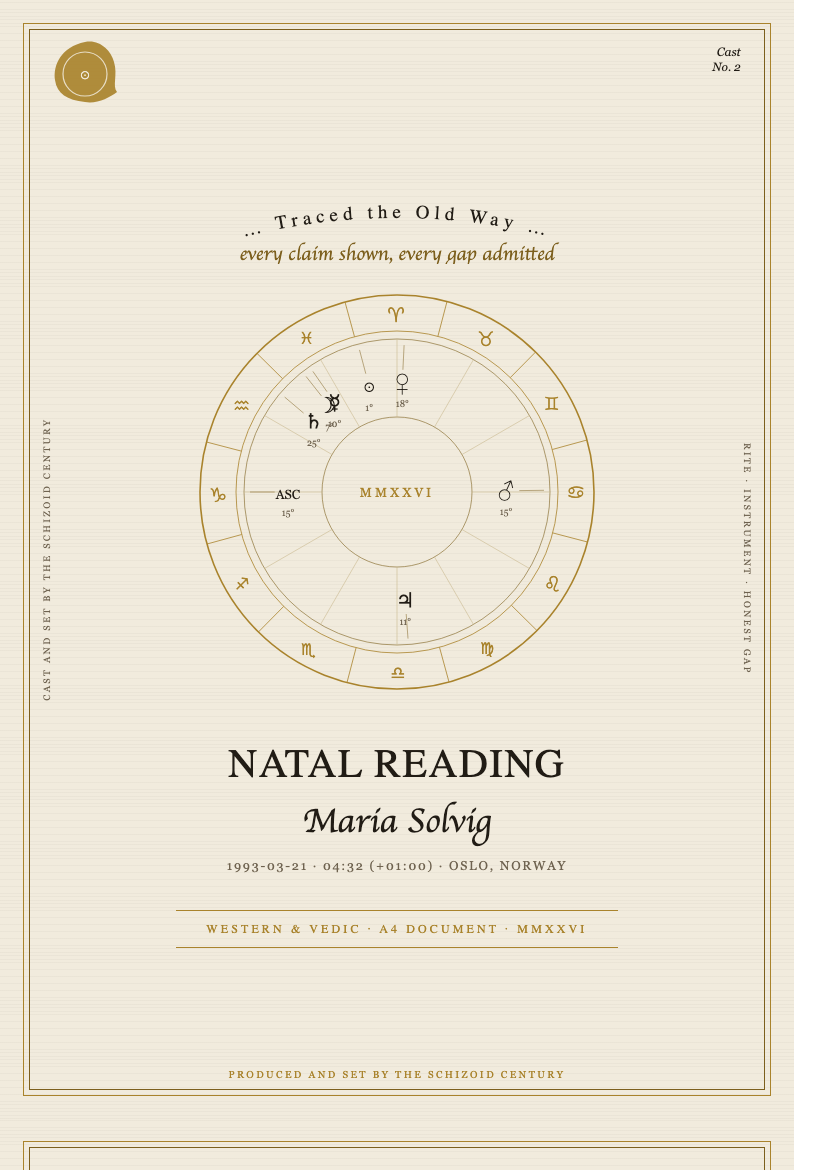
Your chart wheel drawn in gold, a wax seal, the cast number, your name in script.
The reckoning
How to read the document - and your Sun, Moon and Ascendant at a glance.
The method
Four operations worked on your own numbers: place a body, read a whole-sign house, judge a dignity, catch the switch from reporting to promising.
Six worksheet pages
One per domain: the derivation at the top, then the question that house puts to you and ruled space to answer it. Money, home, work, partnership, character, the body.
Eighteen questions
Three per domain, answerable in a sitting and uncomfortable to answer honestly - what your work costs your body, which term of a bargain you would change, what you inherited and keep on purpose.
The temperament count
Your placements tallied across the four triplicities and read against the four-humour doctrine. If the count ties, the guide says so instead of inventing a type.
The placements
Two plates: all seven traditional bodies, each set in the three registers.
The sidereal count
The Vedic page - Lahiri ayanāṃśa, Sanskrit signs, your Moon's nakshatra.
The colophon
The house seal, the method stated plainly, and the gift note if it is one.
The numbers, in place
Every placement entry carries its own longitude, daily motion, retrograde state and whole-sign house - printed beside the claim, not in an appendix.
A guide is judged by what it leaves you able to do
Place any planet
Read a longitude and say which sign, degree and whole-sign house it falls in - the operation every chart rests on.
Judge a dignity
Name a placement's domicile, exaltation, detriment or fall, and cite the scheme that assigns it.
Reconcile two skies
Explain why your Western and Vedic charts disagree by roughly 24 degrees, and which of them is arithmetic.
Catch the switch
Spot the exact sentence where any reading stops reporting a position and starts promising a life.
Trace a domain
Take any area of life - money, marriage, vocation - and derive what the scheme assigns it: house, sign, ruler, placement, in that order.
Count a temperament
Tally any chart across the four triplicities and say which humour the doctrine gives it, and when the count refuses to give one.
Audit six areas of your life
Work through money, home, labour, partnership, character and standing with a frame that asks about the parts people skip - and keep the answers.
The instrument, in the open
Real ephemeris, not an app guess
Positions come from the Swiss Ephemeris - the DE431-derived data professional astronomy software uses. Your birth time and place set the houses; nothing is rounded to a horoscope column.
Whole-sign houses, traditional dignities
The reading uses the Hellenistic house system the old sources actually describe, and names each body's domicile, exaltation, detriment or fall - the vocabulary the texts use, not a modern rewrite.
Two traditions, kept separate
The tropical Western cast and the sidereal Vedic count are printed as two distinct pages with the ayanāṃśa stated. We never average them into one flattering blur.
Typeset, then rasterised
The document is generated as a print-grade HTML plate and rendered to PDF at A4 - same engine every order, so a reprint in a year is byte-identical.
The reasons, stated
Because the arithmetic is real and the meaning is not
Where Mars sat at your birth is a computable fact. Whether that fact bends a life is not. Most readings blur the two so the whole page borrows the credibility of the half that is checkable. We split them and label both.
Because a document should survive scrutiny
Every claim carries its source: which text says it, which chapter. If a friend who knows astronomy reads your copy, the numbers hold - that is the point of printing them.
Because the honest gap is the product
The third register on every placement states what neither the source nor the instrument can settle. That is the line most of this industry deletes.
Actual output, unretouched
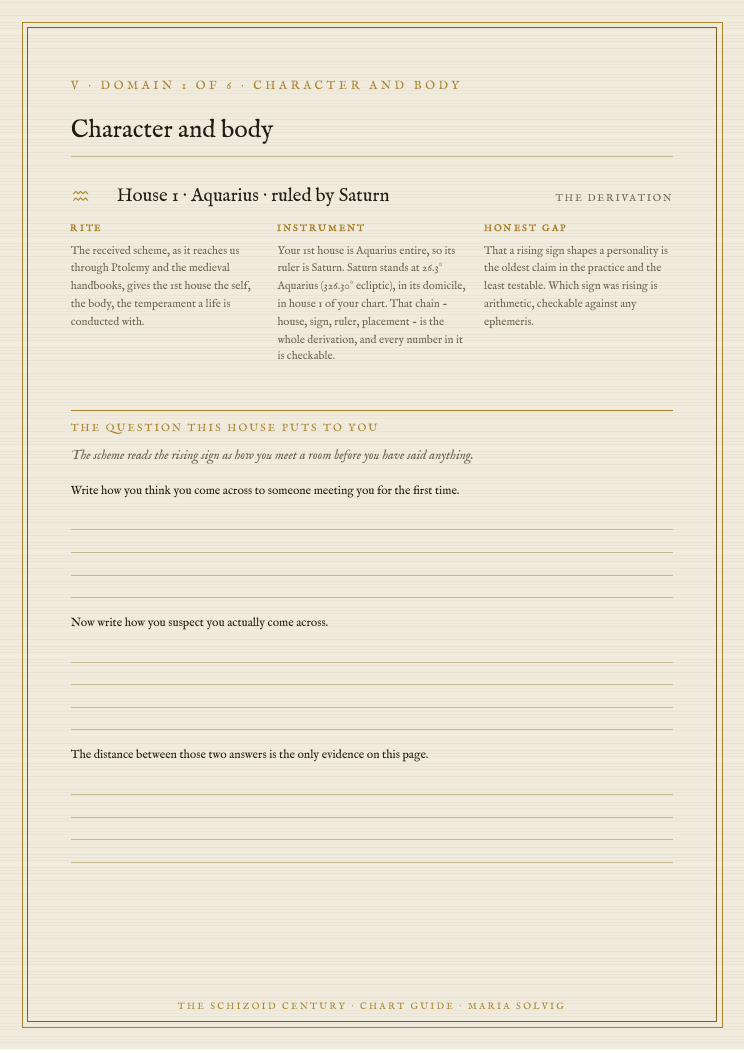
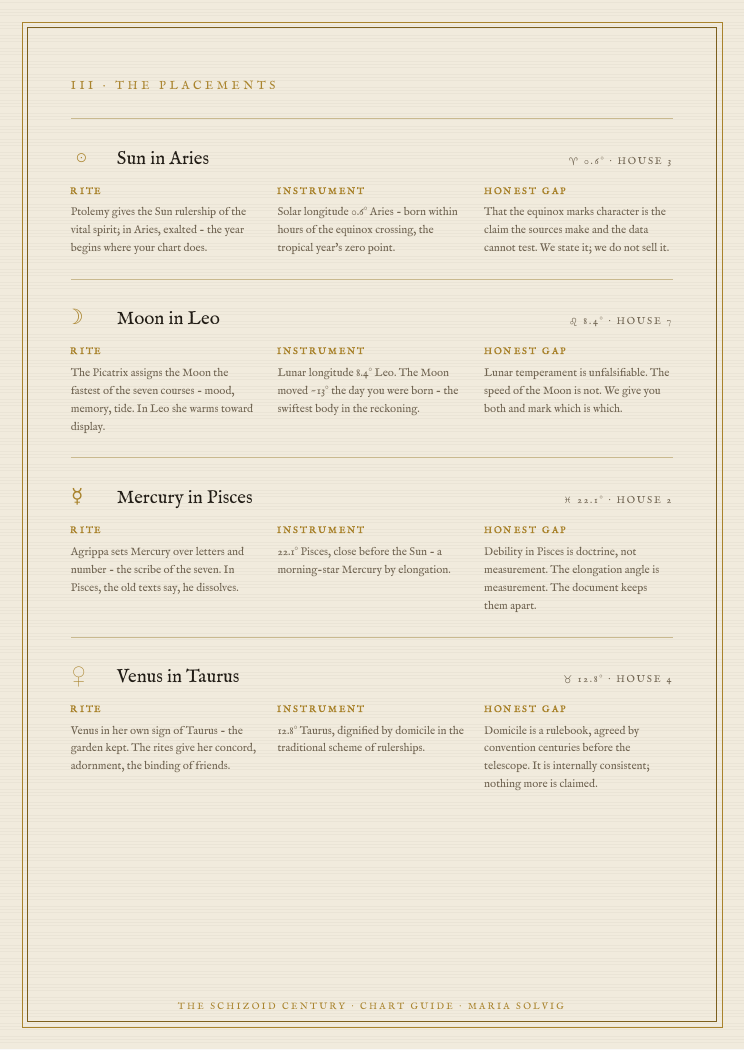
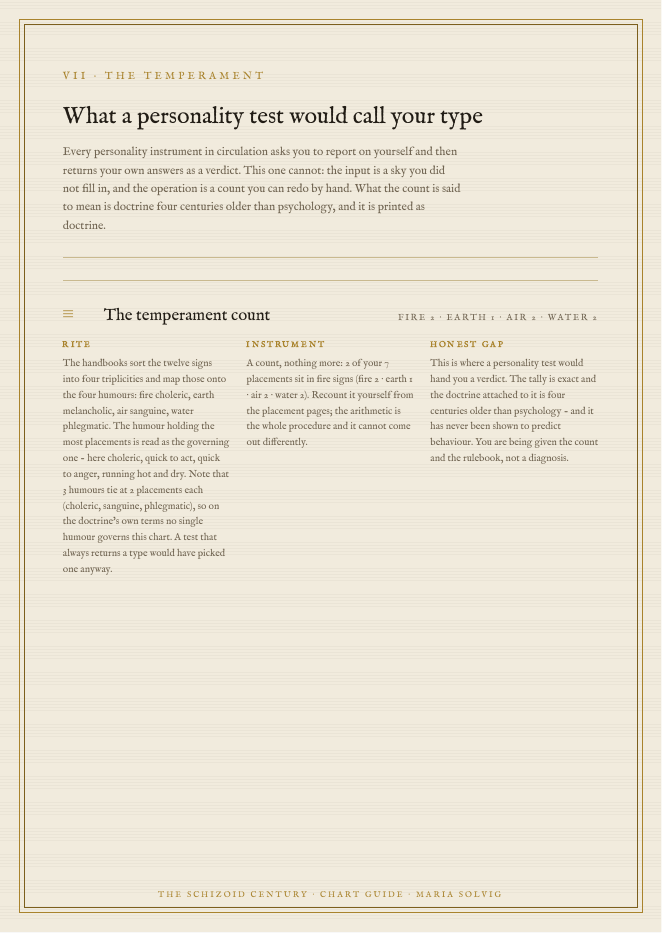
Read the complete sixteen-page specimen · PDF, 2.2 MB
No reviews to show yet - so here is the entire product instead, before you pay.
What the $5 version leaves out
| The Chart Guide | The usual $5 app report | A chatbot answer | |
|---|---|---|---|
| Names its source by book and chapter | yes | no | sometimes, often wrongly |
| Prints the arithmetic so you can re-run it | yes | no | no |
| Same input gives the same output, years later | yes | no | no |
| States plainly what cannot be verified | yes | no | rarely |
| Built to print and hand over | yes | screen only | no |
| Teaches you the method, not just the answer | yes | no | no |
| Runs on data you did not report about yourself | yes | no | no |
| Leaves you holding something you wrote | yes | no | no |
| Promises you an outcome | never | usually | if asked |
We would rather you skipped it than regretted it
Buy it if
- Anyone who likes the tradition but winces at the certainty it is usually sold with
- The friend who reads history for fun and gets bought candles instead
- A birthday, a wedding, a new baby - an $18.98 gift that is a real object, not a novelty
- Astrologers who want the raw numbers alongside the claims
Skip it if
- Anyone who wants to be told what will happen - no forecast is in here
- Anyone who wants advice about their health, money or relationship
- Anyone who needs it in five minutes; every copy is cast and read by hand
What happens after the button
You send the details
Three or four fields. No account, no birth-chart quiz, no upsell page.
It is cast by hand
Your document is generated, then read before it goes out. If the hour gate defers the tracing, you are told the exact window it is waiting for.
It arrives as a file
A print-grade PDF, or SVG line art for a sigil. Yours to keep, reprint and hand on - no platform, no login, no expiry.
- Birth date and time - as exact as you know it
- Birth place - city and country
- The name to set on the cover - yours, or the person it is for
Sent as a gift? We cast around their details and email the document to them - or to you, to hand over.
The correction guarantee
If any number in your document is wrong - a longitude, an hour, a citation, a cell on the square - tell us and you get a full refund, and the correction is published in the journal with your order number on it. If the document does not look like the specimen you read before buying, same terms.
What is deliberately not guaranteed: an outcome. No sigil, hour or placement is claimed to cause anything, and no refund is owed for a life that carried on as normal.
Asked and answered plainly
What if I do not know my exact birth time?
Send your best estimate and say so. Planet positions barely move in an hour; the Ascendant and houses do. The document prints the time it used, so an approximate cast is labeled as one instead of being quietly presented as exact.
Is this Western or Vedic astrology?
Both, kept apart. Pages two to four are the tropical Western cast with whole-sign houses. Page five is the sidereal Vedic count using the Lahiri ayanāṃśa, with your Moon's nakshatra. The two disagree by roughly 24 degrees, and the document says why.
Do I write in it?
Yes - that is the design. Six pages carry ruled space for eighteen answers, so print it or annotate the PDF. The derived half is fixed forever; the written half is what makes the document worth keeping. Date your answers, set it aside for a year, answer the same questions cold and compare. The chart holds still, which is what makes it a useful ruler.
Is this a personality test?
No, and it is built to survive the comparison. A test asks you to rate yourself and returns your own answers scored. This starts from planetary positions you had no hand in, walks a chain anyone can re-walk, and shows you the rulebook. Where a test hands down a type, the guide hands you a count and states that the doctrine attached to it has never predicted behaviour.
It covers money and work - is that financial or career advice?
No. The tradition assigns domains to houses, and the guide reports that assignment and computes which sign and ruler govern yours. Each domain then prints its own refusal in plain sight: the money page says outright that nothing forecasts your finances and nothing there is financial advice. Read those lines before anything else.
Does the reading predict anything?
No. It reports what the historical sources assign to each placement, what the ephemeris actually computes, and where the two cannot be reconciled. No forecast, no advice, no outcome.
How does it arrive, and how fast?
As a PDF by email, cast by hand from your details. Print it at A4 or US Letter - the plate is built at print resolution, not screen resolution.
Go and check us
Two public-domain editions carry every quotation in these documents. Both are linked so you can read the passage yourself - that is the point of citing by chapter.
The Key of Solomon the King (Clavicula Salomonis)
translated by S. L. MacGregor Mathers, 1889 · read the scan at the Internet Archive
The pentacles of Book I ch. XVIII, the planetary hours and virtues of ch. IV, the operating conditions of ch. VIII, and the blank-name instruction of Book II ch. XXI.
Three Books of Occult Philosophy
Heinrich Cornelius Agrippa, 1533; Whitehead edition, 1898 · read the scan at the Internet Archive
The Latin letter table of Book II ch. xx and the seven planetary kameas of ch. xxii - the letter values and magic squares every traced sigil walks.
Cast from the same sources
The Sigil Guide
A seven-page guide to Agrippa's 1533 kamea method, worked on your own name: letter values, the square, the traced route, every step numbered and checkable.
See the pageThe Solomonic Guide
A ten-page guide to the Key of Solomon's operation - the hours, the seals, the seven conditions - with your own hours solved for your coordinates.
See the pageAll Three, Cast Together
Already reading about The Chart Guide? Add The Sigil Guide and The Solomonic Guide for less than the two of them.
$56.94 separately $32.98
· you keep $23.96